
By Elizabeth “BB” Sanford
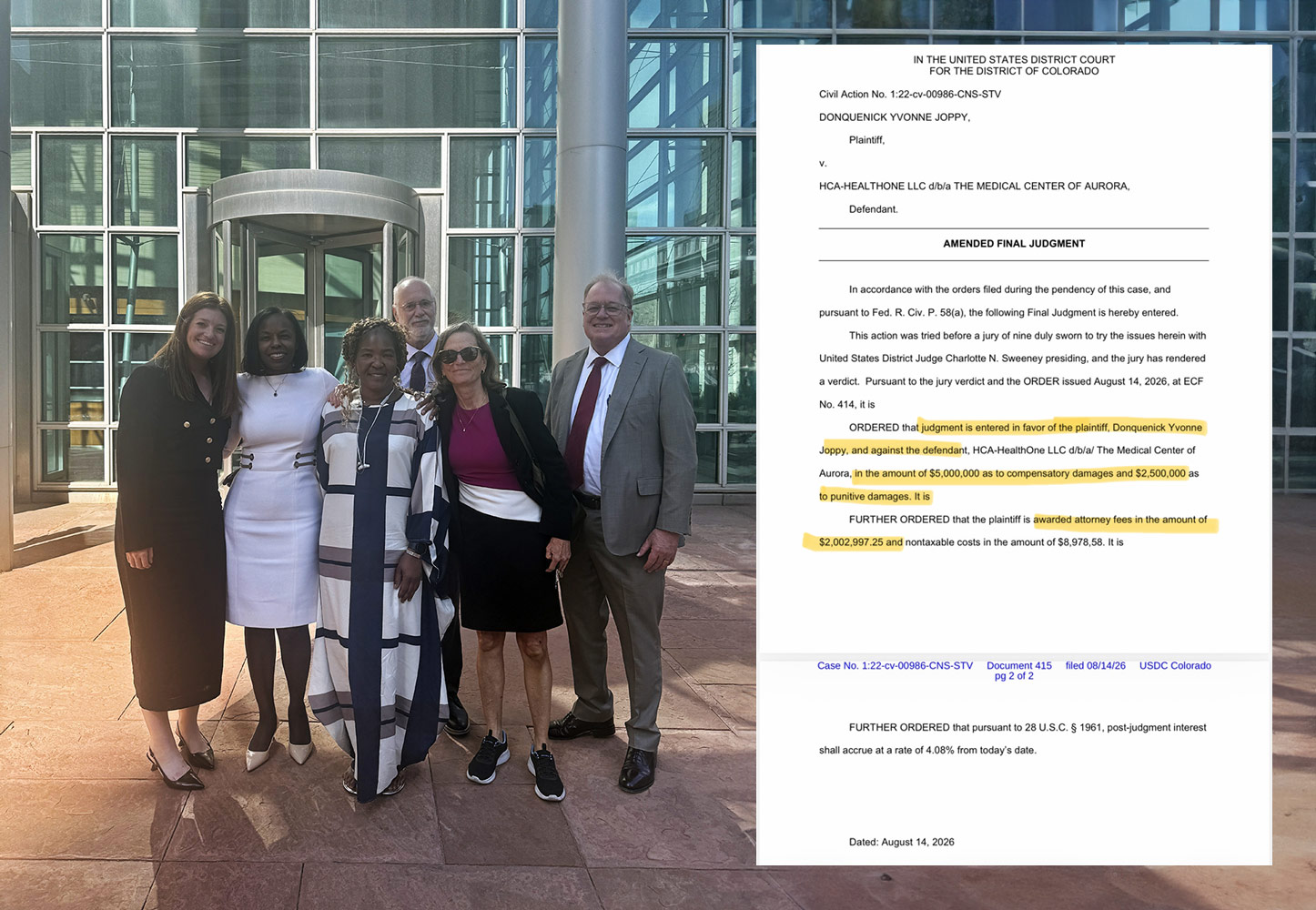
This photo was taken during the original jury trial for this case outside the courthouse. From left to right: BB Sanford (trial lawyer), Jennifer Robinson (lead counsel); DonQuinick Joppy (Plaintiff); friend of plaintiff; Lisa Sahli (lawyer); Brian Sanford (trial lawyer).
A common question I hear after someone serves on jury duty is some version of this: What happens after I go home?
You sit through the trial. You deliberate. You sign the verdict form. Then you go home, and a judge in a robe is still sitting there with the whole file. Can that judge simply change what you decided?
On August 14, 2026, a federal judge in Colorado answered that question in writing, at length, in one of our cases. It is worth walking through because it shows exactly how much weight a jury’s decision carries.
Our firm was brought in as trial counsel on this case a few months before the trial. DonQuenick Joppy had separate lead counsel before we helped and stepped in. So read my enthusiasm for juries with that in mind and hold me to the record. Everything below about the ruling comes from the Court’s written orders, which anyone can pull from the public docket.[1]
The case
The largest hospital company in America, HCA-HealthOne LLC, hired DonQuenick Joppy as a critical care nurse in the intensive care unit at The Medical Center of Aurora, a hospital operated by HCA-HealthOne LLC in May 2017.
After experiencing numerous instances of documented race discrimination, Ms. Joppy complained multiple times to her manager that she was being treated differently because of her race in March 2019. A few weeks later, the hospital placed Ms. Joppy on a performance improvement plan. On May 30, 2019, she put a complaint in writing through the hospital’s internal HR reporting system about the continued race discrimination and retaliation.
The hospital fired her five days later.
The hospital’s stated reason involved a patient who died in the ICU that May, and the hospital’s ventilator policy. Ms. Joppy sued under The Civil Rights Act of 1866, our nation’s first federal civil rights statute. It bars race discrimination in contracts, including employment. She claimed she was fired because of her race and in retaliation for complaining. The hospital denied it and defended the case.
Both sides had documents. Both sides had witnesses. Both sides presented their evidence at trial.
What the jury did
Nine jurors sat through a seven-day jury trial in Denver, Colorado. They deliberated for more than a day.
They found that Ms. Joppy proved both of her claims of race discrimination and retaliation. They awarded her $5,000,000 in compensatory damages, and $15,000,000 in punitive damages.
Then they went home.
What the losing side asked the judge to do
Here is the part not everyone sees.
After a verdict, the losing side can ask the judge to undo it. It’s not a loophole, but a built-in safeguard, and it exists in every civil case. The hospital used it.
It asked United States District Judge to enter judgment in its favor as a matter of law, or to order a new trial, or to reduce the damages. It argued the evidence that race or protected activity actually caused the firing was, in its words, “thin to nonexistent.” It argued the retaliation finding rested on nothing but the timing of the firing. It argued the $5,000,000 was excessive and unsupported, and that because the damages instruction did not expressly rule out economic loss, the jury may have handed Ms. Joppy lost wages she never asked for.
The judge answered in a 126-page order.
What the judge ruled on liability
She left the jury’s findings alone on the existence of race discrimination and retaliation. Entirely.
Her reasoning is the part I want every future juror to read. Again and again, she explained that reweighing the evidence was not her job, even though she had sat through the entire trial herself.
When the hospital argued that its own decisionmaker’s account should have been credited, the judge wrote:
“The Court declines, as it must, the Medical Center’s invitation. Issues of disputed fact, relevance, and witness credibility are, by trial, to be answered by the jury.”
On the retaliation claim, she quoted the Tenth Circuit: “the jury—as the trier of fact—has spoken.”
A federal judge with lifetime tenure, holding the entire trial record, said that the questions of who to believe and what the evidence meant had already been answered by nine American citizens, and that she was not permitted to answer them differently.
What the judge ruled on the $5,000,000 Dignity Damages
She refused to reduce it by a dollar.
A judge may cut a compensatory award only if it is so excessive that it “shock[s] the judicial conscience” and raises an irresistible inference that something improper invaded the trial. She found nothing of the kind here. Quoting the Tenth Circuit again, she wrote that “[i]t is within the virtually exclusive purview of the jury to evaluate credibility and fix damages.”
That $5,000,000 was entirely for what the law calls noneconomic harm. No lost wages. No back pay. The jury heard Ms. Joppy and three other witnesses describe what losing that job did to her life, decided what that was worth, and a federal judge declined to substitute her own number for theirs.
And where the judge did step in
Let’s talk about punitive damages.
The judge reduced the punitive damages award from $15,000,000 to $2,500,000.
She did not do it because she thought the jury got the facts wrong. In the section addressing punitive damages, she found that the record contained “sufficient evidence to sustain the jury’s punitive damages verdict,” and she refused to throw that finding out.
She reduced the number because of the Supreme Court’s prior guidance. The Supreme Court has held that the Due Process Clause limits how severe a punishment a defendant can be made to face. Courts test that with three guideposts: how reprehensible the conduct was, how the punishment compares to the actual harm, and how it compares to penalties the law imposes for comparable misconduct.
Applying those, she found the first guidepost favored Ms. Joppy, and she found the three-to-one ratio between the punishment and the harm constitutionally excessive given how substantial the compensatory award already was. She set the figure at $2,500,000, which she found was still “ample deterrence.”
This is a specific limitation that a judge may choose. It reaches the size of the punishment. It does not reach who wins or what happened.
Where the case stands right now
This case is not over, and nothing has been collected.
Under the Court’s order, Ms. Joppy may accept the reduced punitive damages award or decline it. If she declines it, there will be a new trial. Either side may also appeal.
The sometimes-unglamorous truth is that a headline is not a check, and the fight is not over.
Why any of this should matter to you
If you get a summons, you are going to have a moment where you look around and wonder if this is all just a waste of time. I hope you find that it is not. It certainly wasn’t for Ms. Joppy in this case. A case about a hospital who sought to destroy a nurse’s career after she stood up and protested race discrimination that she was experiencing.
Nine strangers made findings on hotly contested facts, and a federal judge who had watched the whole trial told a large corporate defendant that those findings were not hers to revisit, except for the punitive damages amount.
You decide what happened and what it was worth.
Your part is not the small part.
Your part is the part that nobody else in the building is allowed to do for you.
So when the summons shows up, and you are annoyed about the parking and rearranging your schedule, remember what is actually being handed to you. Nine people in Colorado were handed the same thing, and a federal judge wrote 126 pages explaining why what they decided would stand.
The Sanford Firm served as trial counsel for the plaintiff in Joppy v. HCA-HealthOne LLC d/b/a The Medical Center of Aurora, No. 1:22-cv-00986-CNS-STV (D. Colo.). The rulings described here are set out in the court’s Order and Amended Final Judgment, ECF Nos. 414 and 415, entered August 14, 2026. The judgment is not final. The punitive damages award was reduced from $15,000,000 to $2,500,000; the plaintiff may accept the reduced award or elect a new trial; an appeal may follow; and no amount has been collected. The same order also awarded, and reduced, the attorney’s fees and costs sought by the plaintiff’s counsel. Every case is decided on its own facts and its own law, and past results do not predict or guarantee the outcome of any other matter. This post is offered as general information about the civil jury system. It is not legal advice, and it does not create an attorney-client relationship.
[1] One note on scope. That same order also decided how much the plaintiff’s lawyers would be paid, which has nothing to do with the jury, and it is not what this post is about. But I mention this to you for full disclosure.